
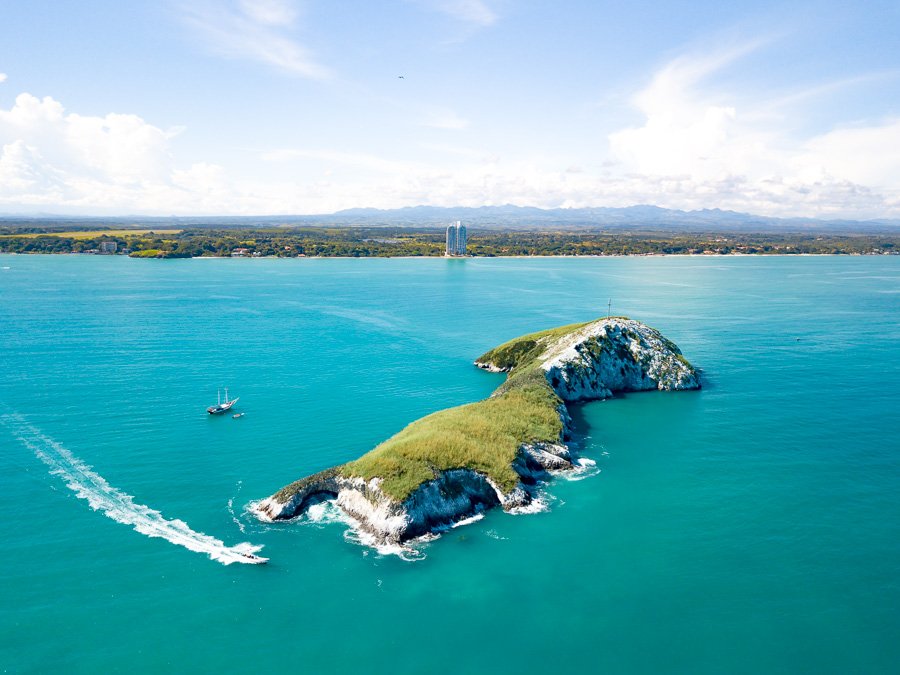
Isla Farallón is one of the most recognizable landmarks on Panama’s Pacific Riviera. Seen from the beaches of Farallón and Playa Blanca, the dark volcanic rock with a cross on its summit looks small and quiet. Its story is anything but. This guide covers what is documented, what is only legend, and how to reach the island on a private boat trip from Vista Mar Marina in San Carlos.
Where Is Isla Farallón?
Isla Farallón, also called Isla Farallón del Chirú, is a promontory of volcanic rock in the Pacific Ocean, off the coast of Coclé province, about 1.4 km from the beach at Farallón, in the Río Hato area. The island is uninhabited. A large cross stands on its highest point, and a tower on the rock has long served as a visual reference for pilots and boats.
The island is crossed by caves. From the western bay, a natural passage of roughly 30 metres leads through the rock to the eastern side, lit almost entirely by daylight. The island already appears on 19th-century maps: cartography from the Granadine Confederation dated 1862 mentions it.
Río Hato: From a Wartime Air Base to an International Airport
To understand Farallón you have to look at the land behind it. In the 1930s the United States Army began using the Río Hato plains as a training and gunnery area, and during World War II the base became part of the air defense of the Panama Canal, with fighters and bombers rotating through. The airfield was handed over to Panama in 1948.
In the 1980s Río Hato became the largest base of the Panama Defense Forces under General Manuel Antonio Noriega, home to elite companies such as the “Macho de Monte” infantry. Noriega also had a large beach house at Farallón, facing the island.
December 20, 1989: The Invasion Begins at Río Hato
When the United States invaded Panama in Operation Just Cause, Río Hato was one of the first targets. In the early hours of December 20, 1989, more than 800 U.S. Army Rangers parachuted onto the airfield. Their objectives were the garrison, the runway and Noriega’s beach house. The operation also marked the first combat use of the F-117 stealth aircraft. After about five hours of fighting the base was taken; dozens of Panamanian soldiers and four Rangers died.
Noriega surrendered on January 3, 1990, and was flown to the United States to stand trial. Today the former base is the site of the Scarlett Martínez International Airport, which receives flights for the beach resorts of the Riviera.
The Legends of Isla Farallón
Few places in Panama have collected as many stories. These are told by people who live in front of the island. None of them has been proven, and they should be read as local legends:
- That Noriega hid his treasures in the caves of the island.
- That explosives were stored in the caves during the 1980s.
- That the rock was once joined to the mainland, and that the land bridge was blown up to isolate it.
- That the remains of Hugo Spadafora are buried under the island’s tower.
The Spadafora Case: The Documented Crime Behind the Legend
The last legend is tied to a real and well-documented crime. In September 1985 the doctor and former guerrilla fighter Hugo Spadafora, an outspoken critic of Noriega, was detained in Chiriquí by members of the Defense Forces. His decapitated body, showing signs of torture, was found across the border in Costa Rica. His head was never recovered.
The murder triggered mass protests, contributed to the resignation of President Nicolás Ardito Barletta and increased international pressure on the regime. In 1993 a Panamanian court convicted Noriega in absentia as the intellectual author of the crime. Where Spadafora’s head ended up remains unknown, and that open question is why the Farallón story has survived for decades. There is no evidence that it is on the island.
Visiting Isla Farallón Today
Today Farallón is a place for swimming, snorkeling and enjoying the coast. Seabirds work the water around the rock, fish break the surface, and the view back to the beaches of Río Hato and Playa Blanca is one of the best on the Riviera. The rock is sharp, so water shoes are recommended, and conditions change with tide and swell.
Majo Fishing Lodge offers a private 6-hour Isla Farallón trip aboard the Hatteras 40 “Makaira” or the Stamas 39 “Majo V”, with music, a barbecue on board, snorkel gear and the option to add light fishing along the way. For a shorter trip, the 2-hour Sunset Trip cruises the San Carlos coastline toward Isla Farallón at golden hour.
All trips depart exclusively from Vista Mar Marina, San Carlos. To check dates, write to us on WhatsApp +507 6306-0690.
Sources
- Wikipedia: Isla Farallón (Panamá)
- Wikipedia: Battle of Rio Hato Airfield
- La Estrella de Panamá: Río Hato, 20 de diciembre de 1989
- La Estrella de Panamá: La muerte de Spadafora, detonante de la caída de Noriega