
Out in the Gulf of Panama, a short run from the Pacific Riviera, three islands sit close together: Otoque, Boná and Estivá. Otoque is home to two small fishing villages. Boná and Estivá are wild, rocky and full of seabirds. Together they hold centuries of history and one of the most important seabird colonies near Panama City.
Where Are Otoque, Boná and Estivá?
The three islands lie in the Gulf of Panama and belong to the district of Taboga, in Panama province. Otoque is the inhabited one: an irregular island about a mile across, with two hills. Boná sits about one mile to the south and is higher and steeper. Estivá and several smaller islets complete the group.
The Caciques: Careta, Tatalao and Estivá
Before the Spanish arrived in the early 16th century, the region was home to Indigenous peoples. Otoque was first settled by groups led by the caciques Careta, Tatalao and Estivá, who fought the Spanish on the mainland. Their names are still part of the map: Estivá is one of the islands, and Tatalao is one of the neighborhoods of Otoque Oriente.
Conquest, epidemics and forced labor almost wiped out the original population. The area was later repopulated, and today’s islanders are of mixed heritage, like much of rural Panama.
Otoque Today: Two Villages, One Island
Otoque’s population is split between two villages at opposite ends of the island, which are also two separate townships: Otoque Oriente and Otoque Occidente. Life revolves around artisanal fishing and small-scale farming. Otoque Oriente is known for its colorful houses and a colonial-style church that can be seen from the water.
Boná: The Fuel Terminal That Never Happened
Boná’s modern history is a conservation story. The Taboga municipality signed a lease with a company called Bona Pacific Corp. for a fuel and petroleum storage and dispatch terminal on the island. Scientists and environmental groups warned that the project would put one of the region’s key seabird nesting sites at risk, and organized a strong campaign against it.
On December 5, 2019, Panama’s Ministry of Environment (MiAmbiente) declared Boná, Estivá and the nearby islets a protected area. The Isla Boná Wildlife Refuge covers about 92.6 hectares of land and 388.6 hectares of sea, and aims to protect seabird habitat, corals, fish and cetaceans. Local fishing communities can continue working in the area. Some islanders said at the time that they had not been consulted, a reminder that conservation and livelihoods have to go together.
Wildlife: Frigatebirds, Boobies and Whales
Boná is a nesting and breeding site for thousands of local and migratory seabirds. Visitors often see magnificent frigatebirds in their courtship displays, blue-footed and brown boobies, and pelicans fishing around the rocks. Under water, rocky reefs hold snapper and other reef fish. Between August and September humpback whales pass through the Gulf of Panama, and dolphins are common throughout the year.
Because Boná and Estivá are a wildlife refuge, the right way to enjoy them is from the boat and the water: watch the birds, swim, snorkel and leave the colonies undisturbed.
Visit Boná and Otoque with Majo Fishing Lodge
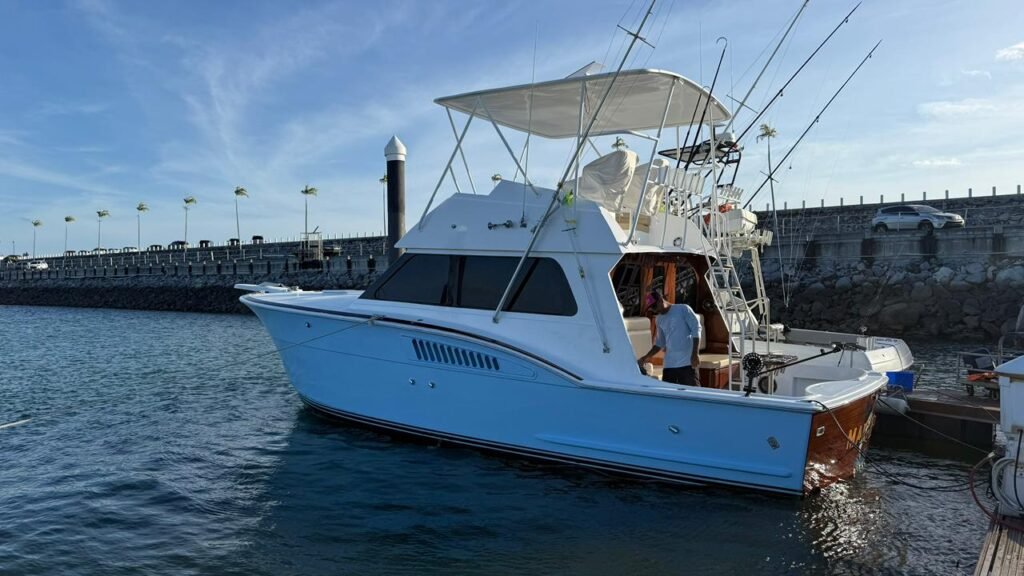
Our private 8-hour Bona & Otoque island trip runs on the Hatteras 40 “Makaira” or the Stamas 39 “Majo V”. It is a relaxed island day with coastal scenery, swimming and snorkeling, and light fishing can be added along the route. If you are visiting in August or September, ask about our whale-watching trips.
All trips depart exclusively from Vista Mar Marina, San Carlos. Check dates on WhatsApp +507 6306-0690.
Sources
- Wikipedia: Isla de Otoque
- Panamá América: Isla Boná y Estivá son declaradas áreas protegidas por MiAmbiente
- La Estrella de Panamá: Isla Boná será declarada área protegida
- Enlodados: Una visita a Isla Otoque e Isla Boná y Estivá